State of Belief
Paul, Brad, and the Kids: A Snapshot of an American Family for Pride

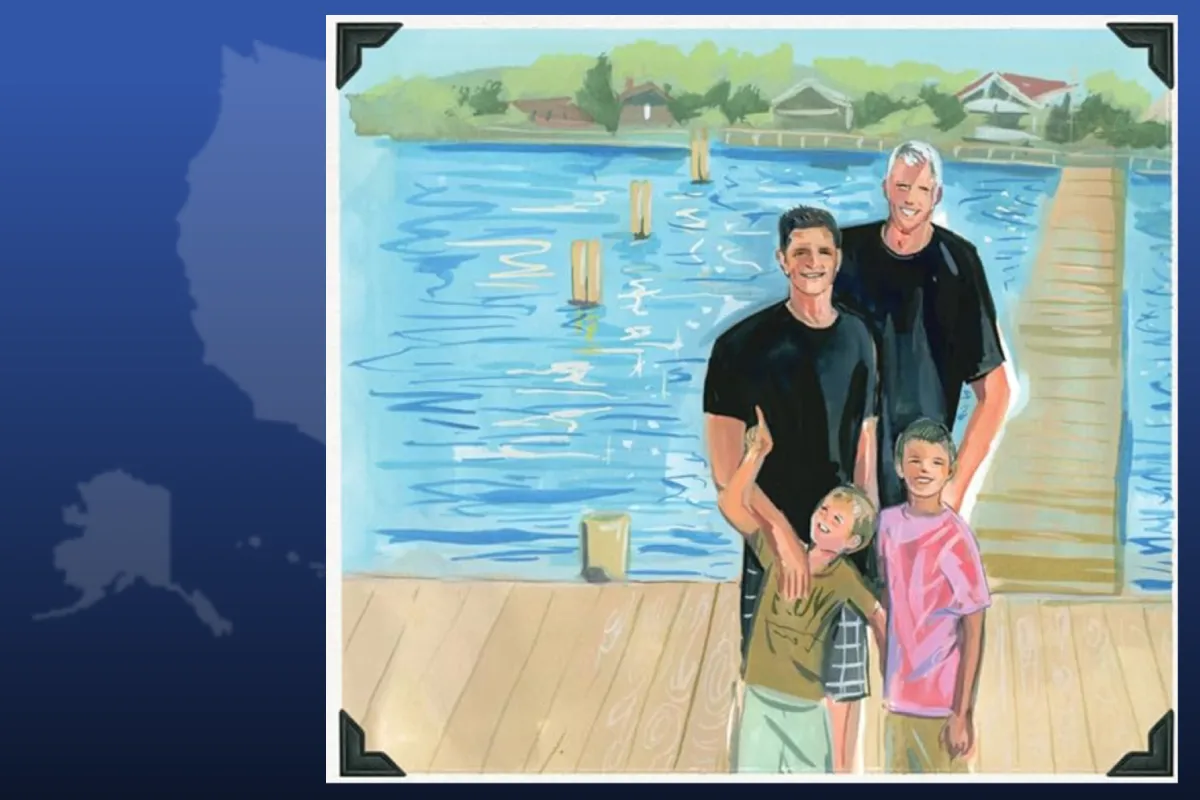
Can a family be radical, and radically ordinary, at the same time? The question came up as I interviewed my guest this week – author Brad Gooch, who happens to be married to host Rev. Paul Brandeis Raushenbush, and the other dad to their two kids.
Brad has written a book, Good Morning Moon: A Snapshot of an American Family, that’s both a personal memoir and a loving telling of their family’s story. During Pride Month, as same-gender families are being challenged on religious and political grounds, it’s wonderful to step away from the struggles and celebrate just how beautifully ordinary this radical life has turned out to be.
It’s also wonderful to celebrate how marriage equality, the law of the land since 2015, has turned out not to be the affront to religious freedom and traditional values despite all the fearmongering we’ve all endured. Guthrie Graves-Fitzsimmons authored a comprehensive new Interfaith Alliance report, Same-Gender Marriage and Religious Freedom, and he joins me to share some highlights.
More about our guests:
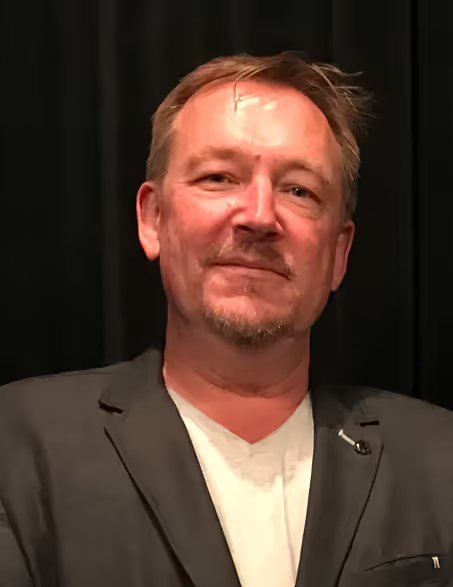
Brad Gooch is a best-selling poet, novelist and biographer whose books include biographies of Keith Haring, Frank O’Hara, Rumi, and Flannery O’Connor. His latest book is titled Good Morning Moon: A Snapshot of an American Family. It’s part memoir, part mystery, and a profile of the way many of us have been living, particularly since marriage equality became the law of the land.
Dr. Guthrie Graves-Fitzsimmons is Senior Vice President of Programs and Policy at Interfaith Alliance. Also living in a same-gender marriage, Guthrie is the author of Just Faith: Reclaiming Progressive Christianity.
Transcript
REV. PAUL BRANDEIS RAUSHENBUSH, HOST:
Brad Gooch is a best-selling poet, novelist, and biographer of spiritual and religious authors such as the Sufi poet Rumi and the author Flannery O'Connor. He's also my husband and the author of a new book titled Good Morning Moon: A Snapshot of an American Family. The family happens to be ours.
The book is part memoir, part mystery, and a profile of the way many of us have been living, particularly since marriage equality has become law of the land. As people around the world celebrate Pride Month, I'm really happy to be able to share this conversation with you today. So, Brad Gooch, welcome back to the State of Belief.
BRAD GOOCH, GUEST:
Thank you, Paul. Good to see you as always, 24-7.
PAUL RAUSHENBUSH:
My god, we're starting off already with the dirge. Not escapable. So you have been on this show before. Before I arrived, you had a conversation, I think, with Welton Gaddy about your book on Rumi. And so you're not a stranger to talking about the issues of this show, which is religion and democracy.
Today we're going to have a conversation about how that translates into the life of a same-gender marriage family with children in this moment in 2026, which has both incredible promise, but also feels a little bit perilous as we celebrate Pride Month. So, welcome to the show. And let's just start with your own kind of interpretation of, what was the genesis of this book Good Morning Moon. Why did you decide: you know what, this is the next book that I'm gonna spend time writing?
BRAD GOOCH:
Well, I'm not a dutiful diary-keeper, but there's certain moments when I've kept journals, when life sort of got up to the pace of fiction. I mean when things became intense and I was really wanting to record them, record the vividness, work out the feelings around them. This happened once when I was modeling in Europe in the early eighties and then that turned into a novel called Scary Kisses.
Then my first partner, Howard Bruckner, was dying of AIDS – “lover” we called each other in those pre-marriage days. And again, I started keeping a journal during that period.
Then the third is when we started seriously thinking about having kids and we're beginning to talk to friends and we had the luxury at that point of sitting back and looking at the different options of how we could have children. One was to go to a mutual friend who was not married and wanted to have a child and that we would be sort of co-parenting with her. Then another was a lesbian woman, who would carry the sperm of a gay man and that was a pretty common route in the nineties, I think.
And finally when we were actually having tea and crumpets with our lesbian friend who I expected to present us with a list of women in Brooklyn who are looking for gay men to have children with she said, well, why don't you two do this together? It would be a great project for you. And even though that's a very obvious solution, I sort of shied away from it. The word “project” made it seem like very New York and part of our life, I guess, in some way. But then that actually caught fire and of our, really, just of moving forward to have children together. Which also, then, took a lot of exploring and discovering.
PAUL RAUSHENBUSH:
A lot. And we did a lot of exploring and discovery. But let's go back. You're from Wilkes-Barre, Pennsylvania. Your grandparents were both miners. Your parents were very, like, kind of a fifties Republican, almost, you know, out of some movie. And then you got to New York. Why don't you tell us a little bit about what it meant to be a gay kid in Wilkes-Barre, Pennsylvania, and then decide to come to New York almost because it was like a a place of radical exploration. And you came to Columbia, right?
BRAD GOOCH:
Yeah. Growing up in Wilkes-Barre in the fifties and sixties, there was the extreme of don't ask, don't tell, I suppose I would say. I mean, it wasn't repression in any overt sense. it was just, nothing was ever talked about. And so there was some bullying and things, but it was mainly there was no word for what I was feeling, except that I began to discover those words by going into a newspaper store on Public Square that had the Village Voice and the East Village Other. And I discovered Goldstein's Deli with The New York Times. And then you would start counting - if you were eagle-eyed little kid - you would start coming across ads for gay films in the Village Voice, for instance. So that this was part of what was the siren call, you know, to come to New York City was meeting other kids who were off in the way I was off.
PAUL RAUSHENBUSH:
Well and part of the draw was coming to Columbia, and it was a radical time and you came in like 1970 or ’71, and that was a moment when gay liberation was just happening. So, we talk about Stonewall and that was in recent memory in New York when you got to New York.
BRAD GOOCH:
Sure. Well, my life would have been totally different if I hadn't, on the first week that I got to Columbia College, found my way to the gay lounge, which is in the basement of Fernald Hall. It was the first safe space like that in the country. And there was like ten of us guys at that point. Columbia was all boys. And every so often someone like W. H. Auden would come visit, you know, and then there were also gay dances in Earl Hall every month.
And we had our version of politics since there was a lot going on at Columbia at that point. And if there had been Vietnam, there was now Cambodia. We're taking over buildings. Our version was going to the dean and having a sit-in to insist on furniture for the gay lounge. Not nothing.
PAUL RAUSHENBUSH:
Well, creating space.
BRAD GOOCH:
It was transformative because I became, then, part of the more downtown gay community. And then lived through the liberation of the 70’s and then AIDS in the 80’s, eventually gay military, gay marriage, gay families.
PAUL RAUSHENBUSH:
Full disclosure, Brad is thirteen years older than me, twelve, I think, twelve and a half. And so your trajectory has really seen a drastic change in what gay life meant. And I think one of the things that has come up around this book is, fast forward, we eventually did decide to have children. We have two incredible kids.
Is what we are doing, is it a radical thing or is it a radically, you know, heteronormative thing? How to describe what we are doing, creating a family, going to drop our kids off at school every day and like, you know, helping them play chess. All these things that feel like very mundane parental things. And yet it's also two dads doing it. Have we caved in to the pressure of heteronormativity, or are we actually doing something radical on our own?
BRAD GOOCH:
Well, it's interesting, the book has been out long enough, one week now, that then you start getting reactions. I mean, you start seeing how people are looking at this. And one question I get a lot is, is this conservative and is this traditional or is this radical? You've written a lot of radical books. Isn't this a domestic book in some way? So you trip certain kinds of wires.
I was saying I think that it's like a gay-straight alliance book, in a certain way. You know, women - first of all, I wrote a book about Flannery O'Connor. She didn't write domestic books. She wrote books about cars and guns and things. And so part of why in the beginning, I think, she took the name Flannery O'Connor, a family name instead of Mary O'Connor, was she wanted her stories to be read outside that expectation. So it's also funny then you have a gay guy who wrote a novel called The Golden Age of Promiscuity is writing a domestic book. So is is that a rrtrenchmenet?
PAUL RAUSHENBUSH:
And it's like domesticity in a way, you know, and in some ways, really, the focus on home and focus on creating a family. You know, I should mention, this book is coming out and it's not at all written as a political book. It's very, like, we did this, we did that. We went through this exploration. We found one another and then we decided to create a family. It's not written as a political manifesto at all. It's just a beautiful story. I love this book - and I'm biased, but I really do love it. And many people who are reading it love it.
But in the context of today, and I do want to just bring that in, support for same-sex marriage, after rising continuously for years, has seen this precipitous decline - specifically in the Republican Party. I should say it has not at all leveled off or or gone down among Independents or Democrats; it's still high, but we're in a moment where all of a sudden we're looking around and people are declaring that they have targeted our marriage.
You know, I'm just curious - because you definitely didn't write a political book, but all of a sudden, now, it is de facto a political book because it tells a story, a snapshot, of an American family. That's a broad claim.
BRAD GOOCH:
Right. I mean, my intention and what I think the book does is was to record this event - and not even the children. In the beginning, what was driving me to record it in some way in journals - and someone said, no, they didn't think that anyone has quite done this - was tracing the medical legal map that you had to go through. And this was a brave new world, the gestational surrogacy and using an egg donor, all of that.
And so that kind of path people are on, and it's very unusual, and I don't think everyone out there knows it. So it was partly, yeah, what I've always done. I mean, it just happened to be the golden age of promiscuity and now it happens to be a moment of gay marriage.
PAUL RAUSHENBUSH:
But it's interesting, even preceding that, you really do record kind of how we met and what it meant to become a partnership and a loving partnership. We met before gay marriage was legal. So people are, how long have you been married? And I'm like, well, okay, our relationship goes back twenty four, twenty five years. We've been married as long as it's been legal, which has been, whatever, ten or twelve. It started with New York State and then Obergefell happened.
But even preceding all of these medical terms is how you get to the place where you're like, okay, I want to do this. And then we go through all of the particulars of how you figure out the question of egg donor and gestational surrogacy. And you have to walk through, in some ways,a really complex maze of moral, ethical decision-making - and relational things, because we had relationships with all these people. And so that has been very interesting.
I do think it's worthwhile backing up and just mentioning that you do have a PhD from Columbia. You're a very thoughtful person, obviously, and go through these things. Tell us about your background as a spiritual person, because it's notable that many of your subject matters and the way you - even in this book, we'll get to that - but there is a religious, spiritual element to to a lot of your writing. Can you let our listeners know a little bit more about your religious and spiritual background and how you came to this place?
BRAD GOOCH:
Sure. I think then you go back to Wilkes-Barre, Pennsylvania again. All roads lead to Wilkes-Barre, Pennsylvania. And my parents were very suburban sixties, classically so. The Jetsons in a ranch house. But one thing is my father was agnostic, and when I was first growing up there was no religion at all. And therefore, since something was being kept from me, I got very curious about it. And I would watch Mass for Shut-ins on television, or Billy Graham rallies. And then I started going and visiting all of my friends' churches or synagogues. And so I was kind of curious and drawn to church, religion, spirituality with no expectation.
Finally I got my mother to bring me to a Presbyterian church that was her childhood church, which required driving to. And then I developed a crush on the minister, Rev. Collins, and I got him to baptize me. Then I was age thirteen or something, was in his office with my parents, wondering what is going on here. The return of the repressed for my father, this interest in religion.
And it stayed with me. I mean, one interest I had in Columbia College was that Thomas Merton had gone there. That was a big book for me in high school, Seven Story Mountain. For a while I wanted to be a Trappist monk and had gone to stay at Gethsemane a couple of times. So I remained drawn to spirituality. And then both as gay man and not really having any faith tradition that I was supposed to espouse, always was a kind of tourist, I think. I wrote a book called God Talk: Travels in Spiritual America that was taking that view. But I would always write essays; I had a spiritual father at the Episcopal Church and became Episcopalian; I wrote about Rumi.
PAUL RAUSHENBUSH:
Well also your PhD was around the connection between…
BRAD GOOCH:
…The sermons of Lancelot Andrews and T. S. Elliot.
PAUL RAUSHENBUSH:
Yeah, that's very interesting. So all of that is a deep interest in spirituality, but also being gay and being part of a radical gay tradition, it's always been a little bit push-pull. But one of the reasons, when we first started dating, you were attending Saint Luke's in the Field, and that was one of the churches that had done AIDS funerals. And so that had been a place where, the Episcopal Church was a place where people who were dying of AIDS in a very pivotal moment in New York – now, I can't speak for every Episcopal church, but Saint John the Divine, you know, you wrote a book about Keith Haring, they had a memorial service there.
And so we actually attended Episcopal church. That was a big part of our family life. And we got married by an Episcopal priest who had actually been a seminary friend of mine, Mary Falk, Mother Mary Falk. And so it has been a part of your life has been religion.
And I'm just curious: so our two sons, Walter and Glenn, were born. And the book is beautiful because you give each of them a section. You really go deep. The book, the first five to seven years of their life. We've kind of closed it now. But talk to me in kind of spiritual terms about what it felt to be writing about these lives that we, with these women and with the technology and all of our friends and family created. How do you understand that as a spiritual person and as someone who is deeply submerged in kind of religion and spirituality?
BRAD GOOCH:
Well, I don't know how much true understanding you could have of birth and having children without some spiritual frame, in some way, for it. Because you were always hitting the boundaries of language. And you know, religion and poetry have always explored that territory. So I just remember watching the transfer of the embryo into the surrogate and it was on a screen that was like very outer space kind of looking screen where you're watching this little bit of light go across and land, basically. I mean those moments you're aware of God or a larger dimension in some way.
PAUL RAUSHENBUSH:
It's like Genesis, in a way.
BRAD GOOCH:
Or 2001: A Space Oddyssey. And also I'm thinking in terms of writing about the kids that I go to that context sometimes. Especially, I think, our firstborn Walter was born while I was writing this book on Rumi and they were sort of reverberating. And then I had someone at a state university where I was teaching was a philosophy professor and a Tibetan Buddhist. And she said at some point, you know, don't ever tell anyone this, but I feel there's something about the boy who's about to be born and the spirit of Rumi in some way. Which I've told everyone since she said that, but…
PAUL RAUSHENBUSH:
Note to self: Don't never tell Brad to not tell anyone…
BRAD GOOCH:
So, you know, Rumi's poetry, well, that definitely was something that I went to. And then children's literature, also, to me, I could see the same kind of aspect even in something like Good Night Moon, which is the basis of my title, Good Morning Moon. You know, the moon, the surrealism of it all, these were very, to me, sort of spiritual emotions and references.
PAUL RAUSHENBUSH:
Well, what was interesting that I hadn't really put together - and I think any parent or aunt or uncle or any sort of person who's ever read these books, you realize, the kind of Good Night Moon, In the Night Kitchen - there's so many of these children's books that feel so spiritual. And also something that you point out in the book is that, often, the parental figure is not a mom and a dad who are doing this. In Good Night Moon, it's a grandmother rabbit. And there's often the sense of a child interacting with a mystical world. And that takes them outside of a “normal”, quote-unquote, day-to-day existence.
But even Where the Wild Things Are. It seems like there's only a a single mom in the picture, and then Max goes off. So it is interesting to this children's literature about the mysticism of it, and of course the spirituality of it. And we talk about that Walter's first word was “moon”. And you know, because he could always spot the moon, even during the daytime. He spotted the moon before and we would say, no, there's no moon - and then we'd look up and go, there's a moon, you're right!
BRAD GOOCH:
Also a lot of these writers were gay. Maurice Sendak was gay, who wrote In The Night Kitchen, and Margaret Weiss Brown who wrote Good Night Moon. So that that's also interesting, kids’ literature.
PAUL RAUSHENBUSH:
That is fascinating. Both Glenn and Walter, they're so different. So what has been the big reveal for you? We've talked about this: I'm the youngest of four kids, you're the only child. We had never seen children grow up. So just the revealing of people growing, people learning. What has been the big reveal for you?
BRAD GOOCH:
Well, first is, I think, trying to find the references, I guess. I mean, this isn't the big reveal, it's the little reveal, but my agent said to me - this was before I was actually writing, said, It's interesting, when you talk about children, it's like no one else. I mean, in terms of how you're seeing it. And so I remember thinking of the Warhol film Empire, where it's twelve hours just on that skyscraper with little changes of light. And that, to me, was what those first four or six months of having a baby was. It's like something that I always thought looked pretty boring from the outside and becomes completely mesmerizing by each little… Now they're rolling over. So that was part of it.
I think my big takeaway, in a sense, was my first takeaway, which was when we saw our first born being born, and I just looked into his little eyes and thought, I know this guy, in some way. I mean there was almost an intact personality. And then our second child, Glenn, was born and there was a very different intact personality. And they remain that way to now. They're just very interesting contraries and opposites.
PAUL RAUSHENBUSH:
And we made the decision to baptize both of them Episcopalian in the church where we were married. And it was extremely moving. I mean, I just remember just being extraordinarily moved by that. And again, I think I wrote something about it at the time. It's like, I want you to have your own journey of faith. But hopefully this will launch you in wherever that leads you.
BRAD GOOCH:
Right. You were asking about religion and spirituality. I think the closest to my resonance with that is the way that they approach religion and spirituality. I remember we went to Grace Cathedral in San Francisco and there was a Keith Haring triptych altar. And at a certain point…
PAUL RAUSHENBUSH:
And you had just written a book about Keith Haring.
BRAD GOOCH:
So that's one reason there's emphasis on that chapel. And then I walked out and then I realized I could see Walter kneeling in front of it and having - not a even a traditional, he wasn't reciting prayers, I don't think, but he was having this moment. And feeling that. And then one night Glenn was talking to me about talking to God and that he talks to God.
What does he mean by that? I don't know. But that is kind of still, I think, having had to invent it myself, in some way, and watching them also invent it for themselves, even though we do go to church and so there's some frame for it, but that I respond to that as an authentic spectrum.
PAUL RAUSHENBUSH:
Spirituality. Yeah. Well, one of the the reveals of the book actually happened as a surprise to both of us - and especially to you - is that you gave me 23 And Me, and I decided I wasn't so eager to do that. But then you took it and you got some results that were surprising.
BRAD GOOCH:
Yeah, I gave it to you because you were writing about your family, and then you sort of handed it back to me, saying, but then they'll have all your information. So I kept it on my desk, and then one day it sort of whistled at me and I realized you just had to spit into this little Walt Disney vial and pop it in the mailbox. And a few weeks later I get back this message, I think it was: Brad, welcome to you. And then the next screen was: Ashkenazi Jewish 52%. But I wasn't Ashkenazi Jewish 52% as far as I knew. I mean, neither of my parents was Jewish.
And then a little more discovery: I see my mother's family all represented genetically, and my father's Welsh family not at all. And so the father side of my family tree was this Jewish guy, obviously, and I've gotten pretty close to realizing who it was. And it was in a family - go back to Wilkes-Barre, Pennsylvania. Family with thirteen kids, had come from Hungary and were either doctors or lawyers or started hardware stores. And one of them was obviously my genetic father. I don't know if it was a romantic explanation. So that was very interesting. I mean, the first part was that if it turned out I had genetic relatives in Wyoming or far away, I might not have been interested. But all these connections were one one block of separation, almost, from me.
And so I basically knew who these people were. And as a kid growing up, I had always kind of wanted to be Jewish. I learned the Hebrew alphabet. The Chosen was my favorite book. I would go to synagogue. And so that was interesting to me about it.
PAUL RAUSHENBUSH:
Yeah, when I when you took me to Wilkes-Barre, you gave me the tour of Jewish Wilkes-Barre, even though at that point you were completely goy. And I was just like, this is so weird. But you had definitely said, I always wanted to be Jewish when I was growing up, which is so wild.
BRAD GOOCH:
And the new stop on that tour is, we go every year on Memorial Day to put the flowers at my parents' grave. And right adjacent to it is the Jewish cemetery.
PAUL RAUSHENBUSH:
Literally twenty feet away. I mean, you know, it's right there.
BRAD GOOCH:
And unlike when I was a kid, the gate is now just kind of flapping open.
PAUL RAUSHENBUSH:
Well, it's not just since you were a kid. It has never been unlocked until the year that you found out that you were part Jewish. And we've gone there many times: you basically clean the grave, you plant flowers, it's on Memorial Day. It's a tradition. And I just decided we were going to honor that tradition. We're going to go back, and also for the kids to know they had grandparents in Wilkes-Barre. And then the year you find this thing out - the gate is open. I consider that a bit of a mystical moment.
BRAD GOOCH:
Sure. And also, then, pretty close, start turning up these tombstones of the family that was the family, and then the patriarchs of the family. And then going down a little bit, I eventually discovered there was kind of three candidates to be my father, all handsome brothers of this family, none of whom married, all because they had non-Jewish girlfriends, they were Orthodox and they couldn't marry them. And one of those probably was my dad.
And then also I flashed on when I was a kid, my father saying to my mother, “What about your Jewish boyfriend?” at some point during a fight. So it turns out that my bio-father and soc-father, as we called them in genetic testing land are buried pretty close to each other.
PAUL RAUSHENBUSH:
A stone’s throw away from one another. It's wild.
BRAD GOOCH:
And you've got two religious traditions next to each other.
PAUL RAUSHENBUSH:
Yeah. People always ask me like, did it totally shatter Brad's worldview? And I'm like, no, he's not that kind of guy. He's old enough that this isn't a shattering moment, but it is an enlarging moment. It expands your understanding.
But one of the really moving parts of the book is you reflecting on your, I guess we call him a soc-father, but the father that raised you. And you had always felt somewhat estranged from him. That was how you explained him to me before I ever met him, that there had always been a kind of a distance between you, or some sort of tension. And yet this all of this kind of actually had a really beautiful effect on you.
BRAD GOOCH:
Yeah, and I'm not alone, I've discovered. In the seven days since the book was published, someone came up to me after a talk and was saying they had a friend and the same thing happened. I mean that they had a the father who they were awkward with, and then it turns out it wasn't really their father. And working through all that, they came to a kind of understanding and empathy with their soc-father, the father who brought them up.
And I went through this same… It took a while, you know, a year or so, but I began to realize that my father had been there. I don't know how much he knew and when he knew it or if ever, but he certainly sensed it, I think, and he had stuck with us and he had these kinds of resources which helped us have children. I just saw both my parents in a more human way. My mother became like, wow, she could go out and have an affair with… Mom, the housewife!
But similarly with my father, that he became human. And it explained, too, the kind of distance between us. And then the opposite of what I would have thought happened: reconciliation, really, with my father, and the burning away of all those feelings and emotions, also somehow made me a better father. I mean, it was a kind of heart-melting sort of experience to go through. And also I think I'd been kind of sentimental about our children and our children having two dads and was it fair that we had put them in this position of difference and kids are asking them, Where's your mom? So I struggled with that, and I think we both did.
But somehow, then, my attitude changed. You think you have problems? I don't know who my dad is! And finally that what mattered to me was who actually brought me up. I mean, who was there. It's very interesting to have the DNA gimmick - and it's more than a gimmick, but finally it didn't seem obviously had less of an influence on my life than my father and mother who brought me up had.
And same with our kids, wherever they land on their particular story, what matters is the kind of family we created. And that it finally was the big motivation for writing the book, in a way, I think, was that they, in decades hence, maybe, but we'll have a record of how they came to be. And also I always felt that we have kind of a happy family. It's fun. They have a pretty good time. But also, you know, that's a special situation. They have two dads, they have two older gay dads, and for them to have something to remember, and explain the situation for themselves, to explain it to other people, I think, is is worth it.
PAUL RAUSHENBUSH:
The story, just about the dad who raised you, you have this beautiful, beautiful piece of writing. And at the end of it you said, you know, in the end, when I look into the mirror, I see his face. Isn't that wild? But it's actually extremely moving. And as I watched you go through that process and just wondering how you were going to land, it made me so just filled with joy to read that - first of all because your writing is so beautiful, but also that that's where you landed, because that feels very healing, in a way.
We're almost out of time, but I do want to… There's another ending to the book which is really beautiful. We took a trip across the Atlantic on the Queen Mary II with the boys and it was so much fun and it was just about how we interact and them dressing up for dinner and having flambé, you cherry jubilee and just all of that. But at the very end there's a very tender moment. You have a book with you, right? Why don't you just read that last bit, because it made my heart feel very full. So why don't you go ahead?
BRAD GOOCH:
Okay, this is, we had taken the Queen Mary II, which was a gift to Paul for his sixtieth birthday, a family trip. And then we get off in London, get into the car, and Walter starts feeling carsick, a leitmotif for both of them. And it said that, “Glenn says, ‘do you want me to hold your hand?’ An unprecedented gesture. Walter tapped me on the shoulder and said, ‘When he did, I felt better.’ I looked back to catch Glenn's soft hand stroking the back of his brother's hand. There they were, Walter and Glenn, in the back seat, doctoring together the script of the rest of our lives.”
PAUL RAUSHENBUSH:
I think that's so beautiful. The book is available on audio, but also you can find it anywhere. But I I think that idea of, these these kids are going to be tthemselves. We're going to do the best we can, like any parent. That's the thing. At this stage, we're just parenting our kids. and I think that as we celebrate Pride Month and as we think about the future of same-gender families and how we're bringing up amazing kids - there's no difference. Lots of kids are going to have challenges just like in heterosexual couples, but we're bringing up amazing people.
And that's our life's work now. And what's interesting is, it gives us both so much joy - and headache and heartache, but joy. And I think that that's what I'd like to kind of think about, in the end, is, maybe you can pinpoint a moment of joy and we can stop there, for bringing up kids. And by the way, I hope, listeners, you are recognizing our kids are going through it. They're going to school and doing well and then not doing well. All the things, all the things, but it's an extraordinary thing that nothing, nothing for me has been as interesting and as powerfully spiritual. So go ahead.
BRAD GOOCH:
And also exciting.I think that's that moment at the end, it was their writing the script of our lives. Meaning they have changed us. They changed us and they have their own sort of way, you know, it's not like we're in charge and they're doing it. So a moment - just because we're in that section - a little bit before that, the night before we landed, Glenn, our younger son and I were on the bed in our cabin looking out at the water. And Glenn sometimes - I don't tell him bedtime stories, he tells me bedtime stories. And this was about - but he wasn't telling it as a story. I mean, particularly, he was saying, you know, before I was born I was living in another world and it was a very warlike world and people were fighting all the time. And I said, I want to be born in that world. I want to be born to daddy and papa and Walter. And he said, so I chose to go to that family. And that was us. And so he was basically saying, whatever the mechanics and the truth or the not-truth, that there's always this feeling that he chose us. And that was a kind of breakthrough moment too, I think, for me, or definitely moment of joy.
PAUL RAUSHENBUSH:
Brad Gooch is the best-selling author of books, including biographies of Keith Haring, Frank O'Hara, Rumi, and Flanner O'Connor, as well as books on spirituality and wisdom. His latest book is titled Good Morning Moon: A Snapshot of an American Family.
Brad, thanks for the beautiful way you tell our story. And thank you for being with us again on The State of Belief.
BRAD GOOCH:
Thanks for inviting me and see you at home pretty soon.