State of Belief
The Catholic Response to Trump's Attacks on the Church with Dr. Anthea Butler and Rev. James Martin, SJ

Have you noticed how Pope Leo's calm, fearless stance is rattling those in power? He’s not just speaking to Catholics; he's challenging the very idea that religion should be silent in times of crisis, whether the topic is war or the treatment of immigrants.
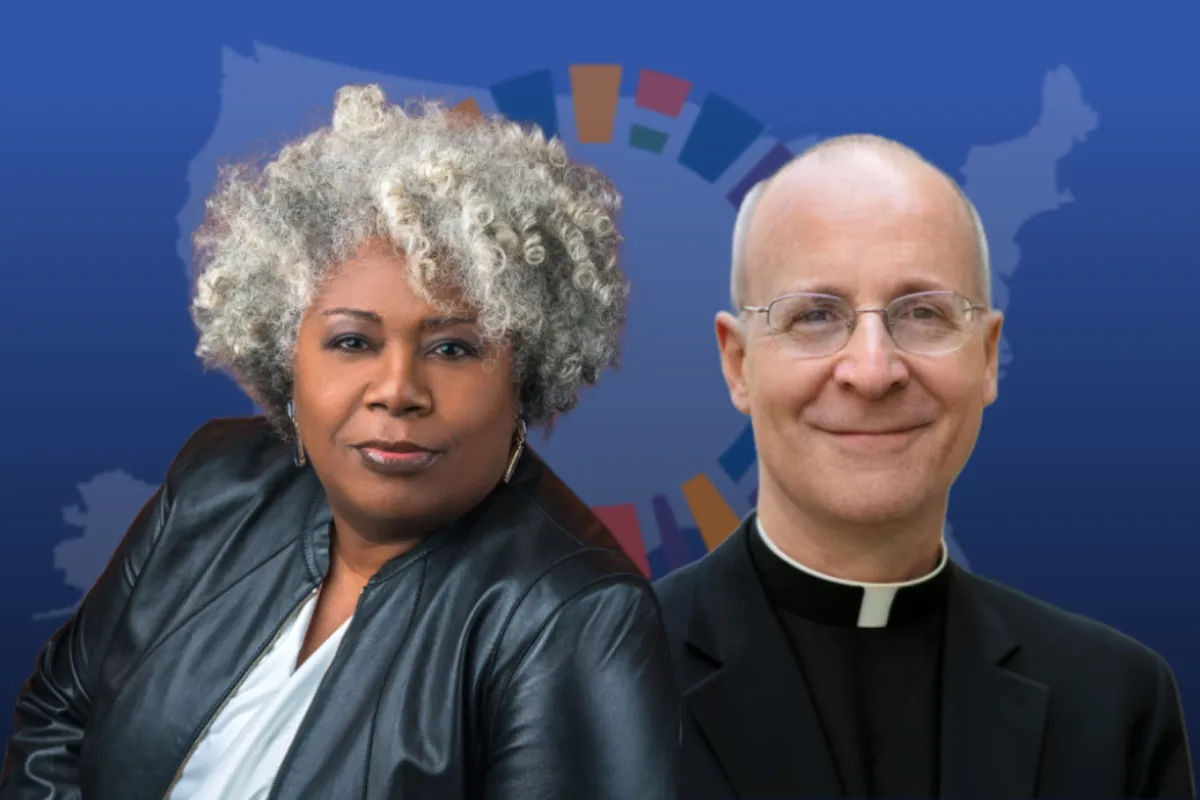
This week, host Rev. Paul Brandeis Raushenbush welcomes two leading American Catholic voices: religion professor Dr. Anthea Butler and best-selling author Father Jim Martin, SJ. They've got deep insights on the ways race, religion, and political priorities inform the furious responses from the White House and other powerful figures—and efforts to deny the moral authority of the head of one of the world's largest religions.
Dr. Anthea Butler is Geraldine R. Segal Professor of Social Thought and Chair of the Department of Religious Studies at the University of Pennsylvania. She's the author of the book White Evangelical Racism: The Politics of Morality in America.
Rev. Jim Martin is editor-at-large at the Jesuit America Magazine, consultor to the Vatican, and author of many books, including his latest—a memoir titled Work in Progress: Confessions of a Busboy, Dishwasher, Caddy, Usher, Factory Worker, Bank Teller, Corporate Tool, and Priest.
Transcript
REV. PAUL BRANDEIS RAUSHENBUSH, HOST:
Dr. Anthea Butler is Gerald R. Siegel Professor of Social Thought and Chair of the Department of Religious Studies at the University of Pennsylvania. She is currently a visiting professor at Oxford University. Her important books include White Evangelical Racism; The Politics of Morality in America, and I'm very happy to have her with us again on The State of Belief, joining us all the way from Oxford.
DR. ANTHEA BUTLER, GUEST:
I'm actually in Oxford. Don't come looking for me though, you'll never find me.
PAUL RAUSHENBUSH:
You heard it, listeners. Dr. Butler, welcome back to The State of Belief!
ANTHEA BUTLER:
Thank you.
PAUL RAUSHENBUSH:
So let's talk things Pope Leo - President Trump. You're over there. You're getting this news not in all the craziness of America. There's almost a clarity that comes from distance. How do you read this current situation with the head of the Catholic Church being attacked personally by the President of the United States?
ANTHEA BUTLER:
Well, first I read it like anybody with common sense would read it - which is basically like, this is not the Pope's problem. It is a Trump problem. I mean, obviously the Pope is in Trump's head and everything doesn't revolve around him. First of all, he was in four major countries in Africa, many of which had different kinds of wars and skirmishes that have happened there. And, you know, talking about peace doesn't just mean he's talking about what Trump is doing. And I just think that Trump feels guilty. And if you feel guilty, then you're going to be upset about everything that a figure of morality is saying.
And so I think what happened is - I'm going to say it in Texanese - hit dogs holler. And he's definitely a hit dog. I'm not calling him a dog, but the phrase is, if it hits you, you're gonna be upset about it. And it hit him.
And I think that this has just been really demoralizing for Americans on our part and also makes Trump look even more - I hesitate to say this word - but I think it makes him more out of control than he normally is. And I think that's really something that's important for people to understand, is that his stock over here was not good in the first place, but now it's pretty much in shambles.
PAUL RAUSHENBUSH:
Yeah, I think that's really helpful. And I think it's maybe helpful for our listeners to be reminded that you come out of the Catholic tradition. So you're obviously a brilliant scholar of religion, but this is also, you've grown up in the Catholic Church, maybe more specifically in the Black Catholic tradition. And so this is something that hits in a different way than me who's a Protestant looking at this, kind of saying, this is fascinating.
I do want to just underline something you said: the only war in the world is not the US-Israel-Iran war. There are wars all over the place, and there are Catholics all over the place. And when Pope Leo talks about, you know, the need for peace, he's not just speaking to the Trump administration, even if they might get that in their head that way. That was so helpful to remember. So that does hit. And it's interesting how he's gotten into Trump's head because that's part of what you can feel in the way that Trump has reacted to this - and others in administration, the lecturing of the Pope by all these men, let's just call it, White men, most of them Protestants on…
ANTHEA BUTLER:
Most of them theologically bankrupt.
PAUL RAUSHENBUSH:
…on Just War Theory and what he should and should not comment on. Was that just when you were like, okay, you can't write this stuff.
ANTHEA BUTLER:
No you can't write this, but this is the arrogance, right? And we know this because we know the Bible. It really outlines something I think Americans should pay attention to, which is this: a lot of Protestants think that they know everything because they have a Bible in their hands and they have understanding and they could search for themselves - this is kind of back to the Reformation. And I think people need to understand that people had a better sense of the Bible in the Reformation - even if they didn't have a Bible - than the people right now who can go buy one for $59.95, if you buy the Trump Bible, who read it and still don't understand it.
So this is where I'm like, you're talking about a man who should watch what he says, but he's been trained, he has a PhD, he's a canon lawyer, he's an Augustinian, very learned order. What do they have to offer? Nothing. And then you have Pete Hegseth quoting Pulp Fiction. I'm just like, you can't make this up. You can't make it up.
And it's just so stupid. It's completely ludicrous. I want to say this because I think it's really important to say, many of us were worried about, at the beginning, this is going to be fascism. This is ignorant fascism. This is like the dumbest stuff I've ever seen in my entire life. And I can't say this strongly enough. We're being talked to and lectured to from people who don't know anything. To the Pope who has amassed a number of scholars around him who can pick out whatever he needs to. If he doesn't know the answer, he's got somebody to tell it to him. But they don't even have enough help to tell them that they're wrong. And that's just a confederacy of dunces.
PAUL RAUSHENBUSH:
I love that. Does it surprise you at all to find the Catholic Church in this position vis-a-vis this administration? It does not surprise you. That's interesting.
ANTHEA BUTLER:
No. No. No. No. Because in the first administration, Trump was picking on Pope Francis. It was for different reasons, but he was linked by Pope Francis there, either. I mean, this plays into conspiracy theories of many evangelicals who still believe that the Catholic Church is the whore of Babylon in the Bible, still believe that the Pope is the Antichrist. So these are playing on tropes that have existed in Protestantism for a long time. So why wouldn't he do it? Why wouldn't he go to the old bag of tricks to start up a new battle with a pope?
The other thing that I think is in operation here, which they wouldn't say, but I do think it's an operation, is that that invitation to come for the 250th that was politely turned down by the Pope to go to Lampedusa, basically said to them: I don't have time for you. I don't care. You can't own me as the American pope. So the comment that he made that, they just picked him to make sure they could control me, is just ridiculous. Because he wasn't in the room, he doesn't get to pick, he doesn't get a choice. And by making himself – well, we're going to get to this, I know - but by putting up that illustration of himself as Jesus laying hands on Jon Stewart was just another part of ridiculousness, you know, and sophomore kind of boorish internet behavior that doesn't make him look like a leader.
PAUL RUAHSENBUSH:
Well, also, let's not forget when Trump put himself on with the Pope hat. I guess what is interesting to me, and I do want to ask you because this is such an important part of your scholarship, is, how is this Pope seen? And I think I'm going to use, vis-a-vis race and the alliance of how immigration is factoring into this? With this administration, the whole world view is racialized with White Christian supremacy. But how do you understand that playing into this? Because I do think that there's something about this that feels, that isn't so explicit at this point, but it's definitely there.
ANTHEA BUTLER:
Well, I think the explicit thing you should think about, is true, is that they had some things to say about Pope Leo, but they didn't have a lot to say about Pope Leo until he went to an African country. I mean, this is where everything got really ratcheted up in a whole different kind of way. So that's number one. Remember that Trump has put a lot of immigration blocks against people in African countries to come to the United States. So that's one. So I think that's part of it.
Two, I think lurking underneath everything is their realization that Pope Leo has a very interesting mixed race background. And that while he may be an American, he spent 20 years in Peru and has Peruvian citizenship, as well. And so this is a way for him to take a swipe, not just at a man who has a mixed race background, but somebody who sort of stayed away from America for a very long time and is not touting his Americanness as the first thing. I think that is upsetting to them because I think they would like to own him and not just in the ways of, we're proud of him; but, we'd like to own him in terms of being a mouthpiece for us. And he's not going to be a mouthpiece for anybody but God. He serves God. He serves the 1 billion-plus members of the Catholic Church. He does not serve Trump.
And the last thing I'll say is that, honestly, I think Trump is just appalled that somebody's more popular than he is.
PAUL RAUSHENBUSH:
I honestly think that a lot of this is that he's intimidated. He is intimidated and he doesn't really know what to do with integrity. He really has no - and we haven't talked since Pope Leo was elevated to the Pope. How did that land with you when you first heard it? Was that something, I’m curious just to go back, was that something that you thought, oh, that's interesting?
ANTHEA BUTLER:
Well, it was even more interesting because you don't know that I was on top of a building about to give an interview for CBS when the smoke came. So I was there. I was there. It was quite amazing. Yeah, I was there. So that was kind of an amazing thing in and of itself. And just to see him come out and be an American pope, we kind of knew - I was there for CBS, and basically we kind of knew.
PAUL RAUSHENBUSH:
You were there. Okay, that is sparking something. I think I do remember that. Okay, okay, okay.
ANTHEA BUTLER:
Somebody there knew it probably was him, and I was like, well, you have an in, you might know - and that person was right. And I won't give away the name because I don't want to mess up their sources, but yeah, they were right. And it was really shocking.
I mean, most of us who are Catholic watchers or writing about Catholicism would have never guessed it would have been an American pope. I mean, it was an amazing day. I didn't get in until like two o'clock in the morning afterwards, but it was just something that we all were scrambling because it was like, who?
But here's the thing, people in New Orleans knew about him because they recognized his last name. And so by three o'clock that morning, people from New Orleans were getting in touch with me saying, you know, he's really a Creole. He's one of us. And that was very interesting to me. So very early on, the news about him and his background was out. And I think it was really interesting. And so I was actually there the Monday after when he did the press thing and just the reception was incredible, it really was. It was like you could just feel the buzz in the room.
Francis was a singular kind of figure. You're not going to ever have a Jesuit pope again, probably. So it was big shoes to fill. But what came out of that was realizing how close he had been to Francis, first of all. And then secondarily, that he had his own quiet way of being. And I remember telling people after I got back, I said, I don't think you can sleep on this guy because he's very different than Francis, but he's going to have a say - and I think a year later we can see that.
PAUL RAUSHENBUSH:
Yeah. Have the Catholic bishops surprised you at all?
ANTHEA BUTLER:
Well, let me tell you what surprised me about them. They finally found a spine. And I think that's great. And I think that part of that has to do with they now realize that - this is not all of them, so let me not lump them all into one boat. But the ones that have been more Trumpian, I would say, have realized that that's not the ship that they should put their bets on.
And that what Pope Leo has been able to do is to sort of coalesce them together to have a message. I think there's that, plus realizing how harsh this immigration thing was going to be. I think they had no idea that this was going to be so bad - not just the optics, but the realities of many people who are of Latino descent, among others, Haitians and others, being picked up by ICE who were actually Catholic immigrants. So it's not just about, you know, we don't like what Trump is doing. It's, you're picking off our flock.
PAUL RAUSHENBUSH:
A hundred percent. And also, crazily, in the first month, JD Vance accused the Catholic bishops of padding their bottom line doing the work that they felt called to do by the Gospel, that they have been called to do since they have been in America. This is not new. And so that felt to me like an unforced error, because immediately it was like, oh, okay, you're coming for us? We see that.
ANTHEA BUTLER:
Well, it's unforced error, what it also does is it makes it a lot harder for him in November. Because I think what he doesn't realize is that he's taken away money from Miami's archdiocese because he got, I believe it was $11 million, if I'm not mistaken, that he took away because of all the Pope stuff. I'm like, know, Catholics who have been really faithful about voting for, I would say, for pro-life, now you don't have to vote for that because he kind of got rid of Roe v Wade, so what are you voting for?
Why are you voting for this man? It's not because you want to see this happen. You're voting for him because you like the pain. You like suffering. You want to see people suffer. And if you like that, then you vote for Trump. If you don't like that, then you should take your vote and take it somewhere else.
PAUL RAUSHENBUSH:
Can you give me - this is such a big term - a gender analysis of all this? Because we have just been talking about men. And it is interesting because the backbone of the Catholic Church...
ANTHEA BUTLER:
He's fired every woman in his cabinet, almost, except Tulsi Gabbert. That should tell you something.
PAUL RAUSHENBUSH:
Absolutely. I'm just talking about, even on the Catholic side, on the administration side, the people of the Catholic Church are women - women religious, but also just women faithful. And I am curious: we don't hear their voice in these big conversations when we talk about Pope Leo, and I am curious how you're experiencing that, how your friends and family on the ground, how is this resonating with women who are trying to also be faithful in this time?
ANTHEA BUTLER:
I think they're faithful to the church and not faithful to whatever Trump has to say. I mean, I think one of the things that has been really interesting for me is that - you're right: you may not be hearing as loud from the sisters or lay women or others, but I think that they're very much a part of what's going on. I mean, what's been interesting to me is that Pope Leo has been meeting with several of the nuns who are in different orders. And I think that's important for him. I don't think he's somebody who's going to say tomorrow: let's have women priests. But I do think he's about trying to do something gender-wise.
Let's talk about the biggest thing that just happened that really says something about him. Who was he pictured with two days ago? The Archbishop of Canterbury, who was a woman! They prayed together, all of this just happened. It didn't make a lot of news, not in America, but it made news over here, obviously. And I think that's the important thing: that he was there with a woman who is the head of the Church in England; besides the king, of course, second in command - and with a series of priests and bishops and cardinals with him.
So I think that to see that he's not seeing women is what's unseen, what people are paying attention to. What the problem is in America is this - and I'll just be honest, America is a very patriarchal society. And we don't like to face that. We don't like to say it, but it's the White male patriarchal society. And so how news gets wrapped out is through this lens of patriarchy and through the screaming and the rantings of men who don't even understand who they're screaming and ranting at and don't understand the purpose.
And so I think it's really interesting that you framed it that way, but the reality is that everybody else is paying attention. There were women all over this African trip, and that he met and went to meet sisters, went to meet, in different places, women who were very much a part of the ceremonies. Africa in certain countries is very male-led, too. But I think that's really interesting to think about in light of how Americans have been positing this argument about the Pope vis-à-vis what's happening in the rest of the world.
PAUL RAUSHENBUSH:
Yeah, that is so helpful. We're almost at the end, but I do think it's really helpful to think about this, also, as Catholic leadership in America. And we think about Kennedy, he broke ground as the first Catholic president. We have a Catholic vice president who has a book coming out, by the way, about his conversion. It's kind of an odd publicity tour, I would say, this attack on Pope Leo when you're about to have a book about your Catholic faith. I don't know. I don't do PR for him. it is interesting. How does this track with a sense of Catholic leadership in positions of power in America?
ANTHEA BUTLER:
I think the trajectory is this: Ithink that Catholic leadership in America has a choice right now. And I think they're actually making the choice. And I think the choice is to do what every Catholic should do: you pay attention to what's happening in your nation, but you follow after the teachings of the Church. And so whether we're talking about Just War or anything else like that, I think what you'd find is that a lot of Catholics – who are maybe not converts, and I don't mean to slam converts here, but I want to talk about people who are cradle-versus-converts.
If you're a convert because you wanted to just think that this was going to make you more conservative, you don't understand Catholicism and you don't understand some of the teachings of the Church with regard to the poor or with regard to war or with regard to faith. And if you're somebody like Vance who's saying, I've gone on a tour to talk about my Catholic-ness, when he basically didn't even do the minimum basic thing which you do to convert to the Church, which is take a rite of Christian initiation and you just get baptized by some bishop because he's your friend and he gives you a couple of teachings - that does not make you a full Catholic. It makes you somebody who's on the periphery, but you haven't, A) lived the experience, and B) you haven't bothered to learn anything.
And I think that promoting a book - and I don't mean to pick on him, I'm just saying, you know, he's had the dubious distinction of being corrected by two popes, Pope Francis and Pope Leo. I mean, like, basically, I would go hide in the corner. I would not even come out and do a book tour about it, possibly.
PAUL RAUSHENBUSH:
Isn’t that something? Has there ever been someone corrected by two popes?
ANTHEA BUTLER:
No, I mean, not unless you were excommunicated. They probably don't even think he’s important enough to excommunicate. I mean, he's being led astray by his theology because it's just bad. I mean, even the least theological person knows that what he's spouting isn't right. Okay. That's, that's number one. And so I feel like what Vance is having to do, which is unfortunate on his part, but he signed up for the job, was do the bidding of his president. And he ends up looking stupid. And I mean, I just think that this book is not going to do as well as he'd like it to do, especially since it's got a United Methodist Church on the cover.
PAUL RAUSHENBUSH:
Dr. Butler, is there anything else that just coming from your position at Oxford, just any words of advice for those of us who are stuck in the mud and mire here in America? Anything that you want to make sure that we hear from your lofty spires of Oxford?
ANTHEA BUTLER:
It's funny to say that, but I do think there's one thing that people should realize. I still think a lot about what was happening in Minneapolis. And I think that the biggest thing that people can do right now, if they wanted to, let's say, act out their faith, or even if they are atheists or agnostics, is to figure out how to be in community with other people. I think paying attention to all of this stuff that's happening right now is very toxic. When I'm here, I'm peaceful. I can look at what's happening and I can really lament the state of the country, but I don't have to feel like I'm stuck in a really bad, dark place.
And I think that for a lot of Americans right now, it feels like a really bad, dark place because it's just embarrassing all of the time to have someone who says crazy things every day, who the people around him say things, that are quoting fake scriptures. We have people around him that are enabling all of these things. And I think that that becomes very debilitating as we go up to the 250th anniversary of this country. I'd like to see people think more about what happens after this, because there will be an after. The question is, how bad will the after be? It's bad now, but how bad will the after be? And what do we do to rebuild on some moral principles that make sense?
PAUL RAUSHENBUSH:
Dr. Anthea Butler is a professor at the University of Pennsylvania where she chairs the religious studies department. She's the author of White Evangelical Racism: The Politics of Morality in America, among other very valuable books. And she is now a visiting professor at Oxford University.
Dr. Butler, I so appreciate your wisdom. Thank you for joining us from across the pond on The State of Belief.
ANTHEA BUTLER:
You're welcome.
---
REV. PAUL BRANDEIS RAUSHENBUSH, HOST:
Rev. James Martin S.J. is a Catholic priest, editor-at-large of America Magazine, consultor to the Vatican Secretariat for Communications, and the best-selling author of books including the profoundly influential Building a Bridge: How the Catholic Church and the LGBT Community Can Enter Into a Relationship of Respect, Compassion, and Sensitivity. He has recently published a memoir titled Work in Progress - and here, wait for it, this is the best title - Work in Progress: Confessions of a Busboy, Dishwasher, Caddy, Usher, Factory Worker, Bank Teller, Corporate Tool, and Priest. Father Martin is a frequent commentator in the national and international media and a valuable voice on Church-State relations and all things having to do with religion and how it affects us in our daily life - but also of how it affects our public life. So Father Jim, it is so great to have you with us once again on The State of Belief.
REV. JAMES MARTIN, SJ, GUEST:
Thanks, nice to be back, Paul. Good to see you.
PAUL RAUSHENBUSH:
Congratulations again on the book. It's literally the most beautiful book. And I know you put that out there and then you just hope people accept it with the beauty and love that you wrote it with. How has it been to get that out there into the world?
JIM MARTIN:
You know, Paul, that's really interesting. It's been pretty surprising in terms of how moving it's been. You always want people to read the book, but there are a few things that people are keying into, and it's a book about sort of finding work and some crazy summer jobs and then finding God as a Jesuit priest.
A couple of things have been interesting. One, people say, that reminds me of my summer jobs. That's been fun to listen to, all these kind of crazy - and everybody has crazy stories. That's the first thing.
Second of all, people are really keying into - my gosh, I grew up in the 60s, 70s, and 80s, and I remember shag carpeting and faux wood paneling and stuff. But really, it's been moving to hear people say it's encouraged them to kind of look back over their own lives and see the ways that God has been at work, which I've found very moving. So giving these book talks and listening to people has been really lovely and pretty profound in many occasions.
PAUL RAUSHENBUSH:
Yeah, we did an earlier episode that really focused on this, but my real favorite thing about the book is that it gives permission to look back, to understand how God was working, rather than, I think there's this idea that everybody has to understand the call and it's just following along with the clearly set steps that everyone must take in order to do the right thing with God. And generally, I don't know that that's how life works with God. It actually, for me, it is so much of a backward-looking story in order to understand this moment, with the encouragement that I can step forward in faith that God is still working even if I don't really always know what I'm doing.
JIM MARTIN:
Yeah, and I think when we look back and see how kind of varied it's been and how crazy it's been, it gives us sort of support in the present when we say, you know, things are kind of crazy now. And I'm sure when we look back in the present, we'll be able to see God's hand. But yeah, that's part of the point of the book, to encourage other people to look back and say, how has God been at work on your, what seems like a kind of a crazy, mixed-up, variegated life. I love that expression, God writes straight with crooked lines. So that's part of the book too.
PAUL RAUSHENBUSH:
I love it, I love it. And you know, the recognition that you and I both - we're both incredibly young, but have also lived a while. And we've had difficult times before. This is another one of those challenging times. And for you, your milieu, and especially right now, is the Catholic Church. You're kind of a man of the people, but you're also very embedded in the Catholic Church and the Catholic mindset and worldview in, I would say, one of the best ways. you're out there speaking about it. This is an interesting time for the Catholic Church.
It’s very interesting for me that the Catholic Church is now in a position of speaking out in a way that remains completely true to the values it's held throughout, and yet it is being perceived in a way that is somehow oppositional to the current administration.
So tell me a little bit about what has surprised you. And we're speaking into this context of Pope Leo, who, when he was elevated, you and I talked about this: this is not a radical person who's going to go out there and be hammering home anything. He’s very methodical, he's very intentional. And yet here we are, where he's been saying things that have put him in at least an internet feud with President Trump. Tell me a little bit about how you're reading this moment for Pope Leo, and then let's get into the broader Church.
JIM MARTIN:
I think that's a really interesting question, and I think there's two things going on. The first thing, and we can talk about this later, is that even before the election of Pope Leo, the US bishops really found their voice when it came to migration. And they were united. And they were united at the US Bishops Conference level and individual bishops. Now, not all of them were as outspoken, but there really was this sort of forceful pushback in terms of the administration's policies.
Then something really interesting happened. We had the election of the first pope, obviously everybody knows that. But you know, Paul, as you were asking the question, I was thinking, I really think that so much of this is because he is an American and he speaks English. Because Francis would have said the same things, right? I mean, maybe not in the exact same way. And other candidates for the papacy, Cardinal Perolin, Cardinal Tagle, they would have said more or less the same thing.
But it's impossible to dismiss Pope Leo in the way that people often dismissed Pope Francis by saying, well, he doesn't understand the United States. Or by saying, well, actually, in the Italian and in the Spanish, that's not what he meant. He meant this. When you have the Pope speaking directly - and I want to say, as an aside, he rarely mentions Donald Trump or Vice President Vance or any person unless he's asked - usually it's kind of about war and peace in general.
But when he's asked, he's not afraid to say, you know, this is what I think. And it is impossible for an American to misunderstand him because he's speaking English. And it is impossible for people who would seek to oppose him to say he doesn't know what he's talking about because he does. Not only because he's an American, but also because he lived outside of America for a long time and can comment on those realities.
PAUL RAUSHENBUSH:
But one of the funny things is that they actually did have the gumption to say he doesn't know what he's talking about. And that was one of the moments where I, you know, mouth drop, where I was like, I cannot be reading this right. I cannot be reading this right, that that JD Vance and President Trump are telling the Pope that he should be more careful with his theology, or that he doesn't really understand Just War. I mean, these are some crazy accusations.
When you heard that, I mean, you must have woken up to this news and been like, my God! Tell me how that landed with you.
JIM MARTIN:
The first sort of salvo was President Trump's Truth Social post really attacking the pope. And I was shocked by that, talking about him as a woke pope and weak on crime, as if he's some sort of mayor or governor. It made no sense. It was really pretty unhinged, very uncharitable, very unchristian. And I thought this is a real sort of breaking of a taboo. Now, I'm sure a lot of people would cheer that and think that's wonderful.
And then shortly after that, Vice President Vance said that he, the Pope, needs to be careful when he speaks about theology, particularly the Just War. Now the irony of that statement was manifold. So one, Pope Leo, like you and me, have master's degrees in theology. He has a doctoral degree in canon law from a pontifical university. And moreover, when JD Vance was saying this, Pope Leo, who is a member of the Augustinian religious order, was at the sort place where St. Augustine, he was in Hippo in Africa, praying there. And Augustine is basically the architect, the original architect of the Just War Theory. So you're telling an Augustinian pope who, while he's visiting, basically, the grave of St. Augustine, he doesn't understand Just War Theory. So it was really shocking.
PAUL RAUSHENBUSH:
Well, and wasn't he the head, at one point, wasn't he the head of the Augustinian order?
JIM MARTIN:
He was, that's right, twice. He was the head of the Augustinians twice. No, it's like me saying to, you know, Babe Ruth or Sammy Sosa or Ted Williams, pick your person: you don't understand baseball. You really need to know baseball a little better.
PAUL RAUSHENBUSH:
Yeah, be careful with your baseball references.
JIM MARTIN:
So it was very condescending and really sort of surprising that another Catholic would say that about the Pope.
PAUL RAUSHENBUSH:
Just about the weak on crime, okay, this is so random, but I think because he's from Chicago and President Trump has a longstanding beef with Chicago and I think that there might be some sort of like - I mean, who knows what's going on in that head, but like some sort of association of him with Chicago, weak on crime, you know, woke. I don't know, but I just think that there was something there that just felt so...
JIM MARTIN:
Well, I think what happened was this, Paul, that came an hour or so after the 60 Minutes interview with Cardinals McElroy and Cupich and Tobin, who talked about immigration and talked about Just War. So I think he was very angry. I mean, I'm assuming because of the timing, he was very angry about that, had religion on his mind. And then of course, he tweeted out the image of himself as Jesus Christ. But I think what's going on is, weak on crime, to me, means you are allowing these supposedly criminal migrants into the country and you don't care about that. I think it's a way of marginalizing his voice.
You know, it breaks this taboo, and after that you saw Speaker Johnson and a number of other people attacking the Pope. So the taboo has been broken. It is now okay to attack the Pope personally and to say he doesn't know what he's talking about. And so it is an attempt, conscious or unconscious, of marginalizing his voice.
But I mentioned to a couple people recently that there's two reasons that's not going to work. Number one, Pope Leo is pretty fearless and he's not attacking President Trump or Vice President Vance, but he's going to keep preaching the Gospel. And two, as Jesus said, my words are not going to pass away. So I think that the response is going to continue, if not directly to President Trump, then to these issues.
PAUL RAUSHENBUSH:
One of the most powerful moments for me was in Pope Leo's response. He essentially said, I am not afraid of you. And that felt really important. And it was rooted in the Gospel. I am not afraid of you. And there's, you know, “fear not”, kind of really rooted in his faith. And also, you think you're the first bully I've met? This just felt really important to hear.
And I latched onto that because fear is a tool. Be silent. He says that to female reporters all the time. Silence, piggy. This is a tactic to make people afraid of him and to silence what he perceives as criticism. And it feels really important that the Pope offered those who might want to feel less afraid, that I'm not afraid of you. And for him, it's because I'm rooted in a Gospel understanding of life. And that was really moving.
I am curious, for you, about the broader Catholic Church right now. I mean, there were some polls that came out that said among Latino Catholics, this has been really bad for Trump. But among White Catholics, it actually has not been so bad. And it feels like reality, frankly, I'm sorry to say. In race and religion, you really have to acknowledge that that's a part of what we're dealing with right now is this kind of racism that is happening across our country and within religion. But how do you understand the broader Catholic Church and this dynamic with these incredible, not only the Pope, but as you said, these bishops and the hierarchy kind of saying, no, we're not accepting this. How do you understand that and the broader understanding of the American Catholic Church?
JIM MARTIN:
Well, let me talk briefly about the fear. One thing to understand about Pope Leo, as you know, is that he was at work as a bishop in Peru, in a very poor diocese. So he understands dealing with governments. He is also, from what I remember at the Synod, he's a very sort of a centered person. And after his election, I asked one of his Augustinian brothers, what's he like? He said, he's very prayerful. He's very kind. We love him. He's great, but he's no pushover. He's really very firm.
And you know, he said, I'm not afraid of the administration. I think President Trump is realizing that he has someone who is speaking out against his policies, who he can't suborn or co-opt or threaten with tariffs or I'm-going-to-bomb-your-country or whatever. He can't. And I think that's frustrating to him.
In terms of the larger Church, I'm actually surprised at those, I did read The Times thing that said it was hurting him with Latinos, particularly the image of him as Jesus Christ. But I'll just tell you, Paul, anecdotally, and maybe it's because I hang around with mostly progressives, but anecdotally, I've heard that the attack on the Pope, and you see this online too, upset pretty much every Catholic in the United States. I mean, unless you are someone who already hates Pope Leo, and there are a few people out there already, I think people were really shocked at how personal it was and how ad hominem it was and just how rude it was. So I can't imagine that that has helped him, that has helped the president in any way.
PAUL RAUSHENBUSH:
That was another one of those moments where you read a poll and you're like, maybe, but let's let this ride out because I'm not sure that that makes sense to me. so I think we're going to find that hardcore Trumpers are going to be hardcore Trumpers, you know? But I think for those people who are still maybe giving him the benefit of the doubt, the attack on the Pope - but then also the whole thing with showing up like Jesus - it was all so unhinged and kind of gives lie to this, like, I'm on the side of the religious folks. I don't think anybody can honestly claim, anymore, that he is on the side of the religious folk - even very conservative bishops asked for an apology. There's people on the Religious Liberty Commission, I think Bishop Baron, he asked for an apology. He was like, this goes beyond the pale.
But I wonder how this filters down, because we're talking big macro level, but ultimately, all of this has implications for the people. And I know for you as a pastor who has a pastoral heart and for priests and for nuns and for people who are working with immigrant communities and people just in the pews, this is hard. This is really hard stuff. And it happened right around Easter. And so I'm just curious how you are hearing about the pastoral cost of all of this political drama.
JIM MARTIN:
People are upset in terms of just the sort of confusing times in which we live. They really were pretty offended. I think that Catholics in a sense close ranks when people - attacking the pope is basically like attacking the Church to a Catholic, right? It's not attacking God or attacking Jesus, but it's attacking the Church. And whatever you feel about the Church, it's your family, it's your home, and so you're going to be protective. You might criticize your family or your mom or your dad or your sisters, but when someone outside does it, it's a little different.
You know, I think by the same token, Catholics are not a monolith, as you know, and Catholic Republicans vote Republican and Catholic Democrats vote Democrat. And so I think it's easier to understand their political responses by understanding their party affiliations. But it's a confusing time. By the same token, I think people are, from what I hear, very grateful that Pope Leo is on the scene because of his desire for unity, because of his unwillingness to engage in any sort of ad hominem attack, and because of his calmness. They call him, apparently, in Italy, Il Papa Calmo, which I love.
And you know, Francis, who I loved, and I think is a saint and will be declared a saint someday, was wonderful. He wasn't Il Papa Calmo. He was very sort of dramatic and kind of effusive and would say things that were off the cuff sometimes. Leo is much more reserved. Now let me tell you, you asked about surprises. One of the biggest surprises for me is this. In the Synod, when I got to know him a little bit, we were at the same table, he was extremely quiet and very reserved - not shy, but very still and very quiet. So I thought, and many people did, that he is going to be very careful about press conferences and speaking to people and answering questions, and it's going to be “no comment."
Instead, he gave a number of press conferences during his papal trip. And interestingly, someone pointed out in the office here, more than Francis. Francis would give one little press conference on the way to whatever country he was going to. He'd visit all the countries, and then he'd give a press conference on the way back. Leo gave several press conferences in air.
Secondly, every Tuesday at Castel Gandalfo, where he takes his Tuesday holiday, he gives, often, a sort of informal press conference outside. So the big surprise for me is that he is, in effect, more vocal and more accessible to the press than Francis was. And Francis was this kind of extrovert, and Leo is a much more introverted guy. That, to me, is fascinating because when he comes out - for those who were in the know, you see pictures of him coming out of Castel Gandalfo at night - he could just blow by the reporters and say nothing. Hey, God bless you. He doesn't. He answers their questions. So that's been a surprise, and kind of a pleasant one, I'll say.
PAUL RAUSHENBUSH:
Yeah, and especially for you as someone who does communications and understands the value of communications and helping the world understand a position it has been really important.
And I'll leave you with one thought that I would love for you to comment on. I saw Timothy Snyder, who's a good thinker, had that book On Tyranny. And he had an interesting take. Did you see this? It was really interesting. He said, Donald Trump's beef - I'm just paraphrasing - beef with Pope Leo is actually not about Pope Leo, it's about God. Because Donald Trump cannot handle any other object of devotion other than himself. And so what he's really doing is vying for the devotion of the people. And Pope Leo represents a threat because he's pointing people towards God rather than Donald Trump. I thought that was, for someone who doesn't, I've had him on the show and he doesn't do religion, exactly, but he's versed, I thought that was an interesting take. Do you have any immediate thoughts about that?
JIM MARTIN:
The answer is, it's very provocative, but who knows what's going on inside of Donald Trump's mind. I think another possibility which you see in his administration is there's also the fear that we can't say God is on our side any longer, which they're constantly doing, like Secretary Hegseth and Mike Johnson and Vice President Pence. And you see that a lot. You know, God's on our side. God loves us.
Now, I do believe God blesses everybody, blesses the troops, God makes the rain fall on the just and the unjust. I think Leo is pointing out that God is on everyone's side. And if, really, God had to pick sides, God is close to the brokenhearted. God is close to the poor in Africa and to the people who are being bombed wherever they are. And so this sort of claiming the mantle of divine protection is also something that is being threatened. And I think that really does, that threatens a lot of people, I would imagin,e based on their comments, that must be threatening to a lot of people in the administration, right?
And just, in fact, just yesterday, Cardinal Robert McElroy, the Archbishop of Washington, wrote an article for us in America Magazine that talked about this war being an unjust one and saying, not only does the Catholic Church have the right to say it's unjust, but it needs to say it's unjust. So those kinds of things, I think, eat away at people who say, God's on our side and our will is God's will. that's really pretty idolatrous, and I think that threatens the administration as well.
PAUL RAUSHENBUSH:
Father Jim Martin is a journalist, editor, bestselling author, and consultor to the Vatican and Rome. His latest book is Work in Progress: Confessions of a Busboy, Dishwasher, Caddy, Usher, Factory Worker, Bank Teller, Corporate Tool, and Priest.
Father Jim, it is great having you every time on The State of Belief. Thank you for joining us.
JIM MARTIN:
Thanks, Paul. Always a pleasure. God bless you.