State of Belief
What Democracy and Religion Look Like Across America
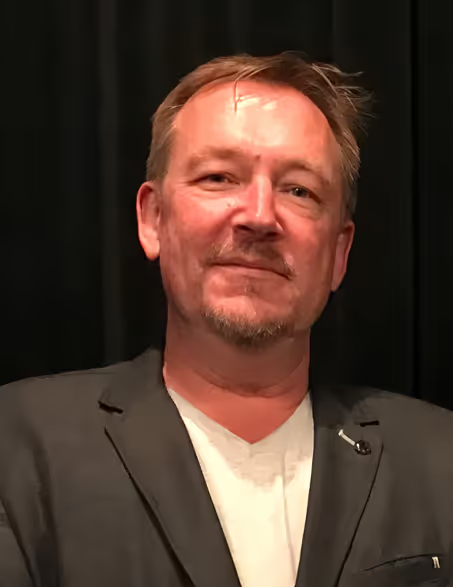

A backbone of the work we are able to do in the pro-democracy faith movement is the network of local Interfaith Alliance affiliates spread across the entire country—in red states and blue states and from sea to shining sea.
As the attacks on religious freedom for all intensify, more and more communities are creating Interfaith Alliance affiliates. At the same time, the longest-active affiliate, Interfaith Alliance of Iowa, just celebrated its 30th anniversary.
So this week, we bring together the longtime leader of Interfaith Alliance of Iowa, Connie Ryan, as well as the head of one of our brand-new affiliates, Rev. Ingrid McIntyre of Nashville, TN. Leading our nationwide affiliate program is Victoria Strang, and she’s also with us to provide a big-picture view of the crucial work happening in so many parts of our nation.
Any group can become an affiliate. Whether you are an existing interfaith organization or looking to start one in your community please reach out to us. You can find the map of our existing affiliates on interfaithalliance.org/affiliate-network. You will see a button on that page titled "Start an Affiliate." just fill out that form and someone from the team will get back to you.
Transcript
REV. PAUL BRANDEIS RAUSHENBUSH, GUEST:
Victoria Strang came to Interfaith Alliance after doing important work at Human Rights Watch, the American Heart Association, and faith outreach positions at a couple other respected nonprofits. Victoria holds an MDiv from Yale and is now director of affiliate partnerships at Interfaith Alliance.
Victoria, welcome to your first - but not last - time on The State of Belief!
VICTORIA STRANG, GUEST:
This is very exciting. Thank you, Paul. So glad to be here.
PAUL RAUSHENBUSH:
You've been with us since, I think, February, or maybe a little bit before. So this is a big time in the world, and you've entered into a new organization. How about if you give us some good first impressions - hopefully good - in your work really continuing to develop our affiliate network?
VICTORIA STRANG:
Thanks, Paul. It has been a whirlwind of a few months here. Sometimes I think it's been a year already, but that's not to say that the work is dragging. It's because the work is so go, go, go constantly, which I think is an example of how engaged and motivated people of faith across the country are in speaking up around pro-democracy issues.
Having worked and led a state-based interfaith coalition in Rhode Island for a number of years, and then working in international, and now coming back to national spaces, it's just been so life-giving to be able to work with our affiliate network and to allow them to do the work that's so important in their communities in the way that they know best. I think that that is just such a gift that we are able to give to our affiliate network while supporting them with resources, training, grant funding, and all of the wonderful things the national office offers.
PAUL RAUSHENBUSH:
This is really important. When I was being invited to consider my position at Interfaith Alliance, I didn't really want to be in a DC office. I didn't think that that was really what I was called to. But when I learned about the history of the affiliate network at Interfaith Alliance and the fact that when we were started, within almost the first six months, a hundred and eighty affiliates around the country. It just popped up, Interfaith Alliance affiliates, because people realized, you know, we don't want just the Jerry Falwells and the Ralph Reeds of the world to speak for religion. We want to take that and speak in our language, which is just as important for our democracy. In fact, it's more representative of America.
And so this idea of a collaboration between a group that's at the national level really looking at national politics but also recognizing all politics is local. And so I think one of the things that you've probably seen is what's happening on the ground in these affiliates around the country actually informs the way we're thinking at the national office. Have you seen that?
VICTORIA STRANG:
Yeah, I definitely have. I think that what we're seeing on the ground is this reclaiming, as you said, of the moral majority. And my sense in working with the affiliates is that there is a renewed sense that our moral voice has been taken away from us by right-wing religious groups. And our Southwest Florida affiliate, they always like to say: we are the moral majority now.
PAUL RAUSHENBUSH:
Mm. No, that's so interesting.
VICTORIA STRANG:
It's really great because I think more progressive faith groups have not necessarily been focused on as much as conservative religious groups have for a long time. And of course, the issues that more conservative religious groups highlight have been focused on for decades, and they've been really organizing around those issues, whereas progressives haven't had the backing to do that. And now that we're in this momentous time, I feel like our affiliates are able to say: we need to stand up, and we need to reclaim that our faith is not represented by the faith that we are seeing in the news and on TV constantly. And that is one that is negative and hurtful and spiteful.
PAUL RAUSHENBUSH:
You mentioned Southwest Florida. One of the things that they started doing was just, like, we're showing up as faith leaders to our city council meetings, to our school board meetings, and saying: no, no, no, we don't want this, we don't want this infusion of Christian Nationalism into our public schools.
And they've also stepped up and said: okay, if you're going to take away the Pride celebration that our community has had for decades, we're going to be part of the groups that celebrate it in a different way; we're not going to let that be taken away from us.
Victoria, you got an MDiv at at at Yale, and so you've had this sense of calling and the importance of faith, in your community in Rhode Island, as you said; in international circles; but then it's just a part of what you think is important, personally. So I just would love to hear a little bit about your background and how you come at this. Where does the passion lie?
VICTORIA STRANG:
I have been very fortunate in that this call has been reinforced to me throughout my life. The real life-changing moment that I had was in college. I was studying abroad in South Africa looking at public health efforts around HIV and AIDS. And even though I had grown up religious in the UCC in Massachusetts, I didn't really understand the community organizing and advocacy aspect that faith groups have. So when I was in South Africa, I remember living in a township for several weeks and I met a pastor there who was wearing a t-shirt that said, “I am HIV positive.” And he wasn't, but he wore the t-shirt as an outward symbol of solidarity for the members of his community that were experiencing that, because it was extremely stigmatized.
And I followed him along, and he would walk people to the clinic to go to their health appointments. He would go from house to house and he would make sure everyone was taking their medication. And he was very open about the need to love all people, our brothers and sisters who are experiencing this. And that opened, for me, a real door into how can faith leaders and people of faith be change makers and an accompanist as we're trying to create social justice and change in our society.
And so since that moment, I've worked in a number of both secular and faith-based organizations to propel this idea. And I feel very fortunate in the work that we're doing at Interfaith Alliance that ours is really a supportive role for those people on the ground who are doing this work and who know their communities. I don't live in Nashville where Reverend Ingrid is. She's lived there, she knows the community, she knows the issues that they're facing. And I want to be able to support her so that she's able to do the work that she knows will create change. And that's something that I think not a lot of national organizations, necessarily, are able to or willing to do, is to put their trust in local organizers.
PAUL RAUSHENBUSH:
I love it. And one of the things I I just really appreciate in that story from South Africa and the HIV - for a lot of us to see that in action, you're like, yeah, this is what religion can do. The power and it can be a source of bringing people together and solidarity and love and support and so we know that. And yet that story sometimes is hard to tell, because people see so so much negativity. And so I just really appreciate that.
Now we want to bring in two of our affiliates leads. One is our oldest - not Connie, Connie is not the oldest person. Interfaith Alliance of Iowa is the oldest. And Ingrid is the lead in our newest Interfaith Alliance affiliate, which is located in Nashville.
Executive Director Connie Ryan is the head of Interfaith Alliance of Iowa. I just was out in Iowa to celebrate their 30th anniversary. Amazing, amazing - basically almost as long as Interfaith Alliance National. And it was great to talk to Alicia Claypool who was the person who started Interfaith Alliance of Iowa, who you honored. And she was like, yeah, well, we looked around and said, well, let's just affiliate with them. We knew we wanted to do something like this, and then we saw them, so let's just do it that. And that celebration in Iowa was so incredible. And 350 people, incredible people loving it, and the way you all are expanding into rural Iowa - I want to hear all about that.
But before we do that, I want to introduce Rev. Ingrid McIntyre, who is our newest Interfaith Alliance affiliate in Nashville. And we got to know each other at the Train the Trainers in Austin. And you just came in with such energy and such commitment and lit the fire. And then the conversation kept going. And so, yeah, actually, this is a good way for us to align. So, welcome both of you to enter into this conversation. This is a very cool panel of people who are working at the grassroots level across the country.
And by the way, a lot of times people are like, it's hopeless.They say, there's nothing we can do. I hear that all the time. There's nothing we can do. Let me tell you, today you're going to learn there's always something you can do. And these people can can testify to that. So I'm going to go first to you, Connie. First of all, congratulations on 30 years. I kind of feel like having anything last is really hard. You know, things ebb and flow, things come and go. 30 years of Interfaith Alliance Iowa, and you all are not just kind of there, you are there, there. Everyone knows about Interfaith Alliance of Iowa. You're a major presence.
Tell me about what it feels like to lead an Interfaith Alliance in a state like Iowa where there's so many dynamics happening at the same time. What it what does it feel like to do leadership? And how do you decide what to prioritize in your work on the ground, which is a statewide affiliate.
CONNIE RYAN, GUEST:
It is interesting work, it is difficult work, it is joyful work, it is the whole spectrum - and I'll just pause and thank you, Paul, for having me on and being in Iowa a few weeks ago, and I greatly appreciate the collaborative relationship that National has with its affiliates, particularly under your leadership.
Working in Iowa, I've done this work almost 24 years and it has changed over the years, and you know our politics in our state and across the nation has changed significantly. And people often ask me, you know, how do you do this and how have you done it for so long? And I usually joke that I'm stubborn, so I'm going to keep doing it till I get it right. But really, the reality is that it takes all of us to make a difference and to do the work; and whether we're working in Des Moines, which is our biggest city in the state, or whether we're working in Algona, Iowa, which is a small town, it just takes all of us to stand up to what's happening - and particularly right now with authoritarianism and Christian Nationalism and the impact.
For me, it's about the impact on people. the issues that we work on have a direct impact on Iowans across the state, and the voice of progressive people of faith and all beliefs is just so critically important in these times. And so we have to stand up and we have to use our voices and we have to empower other people to use their voices, as well.
PAUL RAUSHENBUSH:
And I I know you all are are doing both c(3) and c(4) work. You show up in a lot of different ways, which is the flexibility that c(3), c(4), we have that at the national level, as well. But I love the fact that it is about people and it's about everybody. That's what's so important, is that we're not creating an “us versus them”, but we are creating a “we the people” movement, where everybody should be able to thrive together in a democracy. Otherwise, it's not a democracy, if only some thrive.
Let me turn to you, Ingrid. Welcome to The State of Belief. I'm so glad to see your face and hear your voice.
REV. INGRID MCINTYRE, GUEST:
It's so good to be here. Thank you.
PAUL RAUSHENBUSH:
So Rev. Ingrid, let's just start with: why join Interfaith Alliance? We had a really powerful time in Austin with the training. But what is leading you to want to affiliate with Interfaith Alliance at this point from where you stand in in Nashville?
INGRID MCINTYRE:
Thanks so much, Paul, for having us on. This is important work and an important conversation to have. Like all of you have sort of alluded to, this time can feel really lonely and really isolating, I think. It can feel really lonely and isolating in Tennessee, sometimes, with some of the things that we are experiencing. Most recently, the gerrymandering again of our state map in districts that happened in 2022 to us, and now it's happening again or has happened again.
And so I think being in alignment with other groups from across the country is one of the most supportive things that I can feel right now, that we are not alone, that we are working with Connie and Victoria and all these other people from across the country to say that we are in alignment, I am not crazy. Because sometimes I think you just feel like, am I nuts? Like, this is horrible. And so when you can align with other people and you hear them speaking and you think, yeah, that's the language I'm speaking, too, I just think the solidarity is incredibly important right now for even just our mental health and sustainability of the work that we are doing in the community. So I'm really super grateful.
And one of the things that Victoria said that I just think is sort of what hit me with Interfaith Alliance is the trust. You know, I have a really hard time with orgs that are not on the ground that are sort of grass tops trying to tell the grassroots what to do. And you guys are so supportive and affirming and it provides that solidarity that I'm talking about, and resources that I've learned about just since I've been here for two months. So it's just been really encouraging. I feel like a stronger person, like a stronger leader, because I'm in collaboration with the rest of you.
PAUL RAUSHENBUSH:
That is a beautiful testimony. And I want to make sure that our listeners who maybe are looking for one of the things that's really important is if you're feeling alone and you're feeling like, what can I do? Look around. Maybe see if there's an Interfaith Alliance near you. There's lots. Now we're closing in on forty Interfaith Alliances around the country, which is awesome, and a huge expansion. And we're not done.
So if you are, actually, someone who really feels called to this moment - and by the way, you don't have to be a clergyperson. most of our groups are not run by clergypersons. Some of them are, and that's fine, but - I hope you don't mind me outing you, Connie, as a non-clergyperson. You're very comfortable with that title.
CONNIE RYAN:
Yeah, I have a masters in social work and both my parents are clergy, so I feel like I'm clergy-adjacent.
PAUL RAUSHENBUSH:
But that's just the thing. Clergy-adjacent, but the big thing is that if you think, there's no way I can do that – well, think again. And the other thing I want is for those of you with who have deep pockets, please understand that at Interfaith Alliance, our affiliates don't pay dues. In fact, all the money flows out. We give grants. We try to actually seed amazing work. We can't give as much as we'd like, but we do try to seed amazing work around the country. So that's just something to keep in mind. That's the way the money flows is from national out to the grassroots. It's really an important principle of our work.
INGRID MCINTYRE:
Can I say, really quick, Paul, just while we're on it, just for anyone listening who is in Tennessee, our affiliate is across the state. So, I am in Nashville, but we are a statewide affiliate, and this summer we'll be getting out into a lot of the counties, as we say, that have been redistricted. So please hit us up if you're in Tennessee.
PAUL RAUSHENBUSH:
Great. I love that. Okay, take that seriously in Tennessee, I know you're out there. So let's talk very specifically - because at the national level and at the narrative level, we do talk about something that on this show you've heard a lot about, which is White Christian Nationalism. And we we use that language to describe something, it's not the most precise language, but it is describing something that has been a part of the American project, the American experiment, the America that we know, that's always been there from the very beginning, from before the beginning.
It's at a very powerful moment right now, and it undermines what we like to think of as the actual American Project, which is literally life, liberty, and the pursuit of happiness for all people. And so I wonder, maybe Victoria, when you're talking to all of our affiliates, what are some of the themes that keep reoccurring in grassroots work across the country vis-a-vis this kind of powerful force empowered White Christian Nationalism that we're seeing?
VICTORIA STRANG:
It's definitely a theme that we see throughout the affiliates. And one of the things that we talk a lot about is how, in growing authoritarian regimes, the goal is really to divide people. And I think that that is what a lot of our communities are seeing. And that's not only along political lines, but that's along racial, that's along faith lines. And so when we're able to have these conversations about hate and how to create interfaith groups together and spaces where clergy, non-clergy activists are able to come together - that's really the only way that we are going to be able to combat this system that Christian Nationalism and the growing authoritarian overreach has created.
So a lot of the affiliates are very interested in how do we have these community conversations that allow us to build relationships, while also working towards the America that we want to see and be a part of.
PAUL RAUSHENBUSH:
I love that. Connie or Ingrid, anything to add about how you see Christian Nationalism really showing up in your spaces?
CONNIE RYAN:
Well, for us we do a lot of policy work with the legislature, as you mentioned earlier. We have a c(3) and a c(4), and so part of my work is to lobby at the Iowa State House; and so much of the public policy that's introduced is influenced by Christian nationalism and even introduced by groups that hold those beliefs. And so it's not just something out there that you don't really have to think about or don't really know about. It is very much part of the everyday life in Iowa - and I'm sure in Tennessee, as well. And that shows up in public policy, which impacts people, on a daily basis.
And so whether you're talking about public schools or whether you're talking about LGBTQ issues or reproductive health care or immigration or just the laundry list, it's all impacted by Christian Nationalism and that impacts every day for us, everyday Iowans.
INGRID MCINTYRE:
And it's not only just impactful, the policy that they are writing currently in Tennessee, as well, Connie. It's also infiltrating our churches. You know what I mean? It's the battle cry of a group of people. And again, they're just dividing; they're not trying to make our groceries more affordable. They're not trying to make our taxes, our gas prices less. They're not trying to make sure that we have healthcare expansion in Tennessee. They're not trying to make sure that our public education is funded. They're trying to do these crazy things that are only virtue signaling, really.
So while the rest of our state has issues, they're struggling, there are real folks really struggling while people are in the middle of their culture wars and this White Christian Nationalism that's dominating. I mean, I don't want to say it's dominating, but it's pretty loud.
PAUL RAUSHENBUSH:
It's very, very organized. And, you know, Victoria, as you well know, being abroad and here, religion is a tool of authoritarianism. And so when we talk about Christian Nationalism, this administration has been so actually kind of blatant about how they're using religion to just be one of their pillars of building their authoritarian future, and it's going to be a particular kind of religious people who are the real religious people who get to speak for religion. And then the rest of us - which is the majority, by the way, really, the vast majority, do not get to have a say. We're maybe tolerated and maybe not tolerated. And so Victoria, how are you seeing that being used as an authoritarian effort writ large across the country?
VICTORIA STRANG:
I will say, Paul, thanks for noting that, coming from the international context, because even at Human Rights Watch, this was something that we were seeing in Brazil, in Hungary, in a lot of different countries, religion being used as a tool, really, for these regimes. So it's not, unfortunately, a uniquely American problem, but it's one that has really resurfaced here in a huge way that's impacting a lot of those across the country. And I think it's creating a lot of fear in ways that are creating those silos and are making people think twice about speaking up. And that's why one of the things that has been really interesting since I started supporting the affiliates is how some states and some affiliate leaders are having conversations to really identify what Christian Nationalism is. Because coming from Rhode Island, I feel like people around here have a clearer idea, maybe, of what that is.
But there are other parts of the country where you're saying, well, I'm patriotic, I believe in America, and I'm Christian. So I'm a Christian Nationalist. And there's not that understanding of the history and underlying context of what that actually means, and how it impacts our society, our culture, and now our politics. And I think the people that can speak to that, that are looked at as trusted leaders, are people of faith. So if your pastor is coming to you and talking about what Christian Nationalism is and its detrimental effects, that is going to be listened to more than an organization from DC coming in to your community to say, like, you're wrong and you don't know what you're talking about. And that's why nurturing these relationships and groups is so important.
PAUL RAUSHENBUSH:
Absolutely. I think that's so important because a lot of - and that's deliberate, by the way, the way people are understanding it - because you had, in that rededicate thing on the Mall, they were like, hey, I'm a Christian and I'm an American and if that's wrong… It's like, dude, that's not what we're saying, and you know that's not what we're saying, but you're trying to claim that. And so part of our our role is to say, actually, that's not Christian Nationalism. There is a specific thing that you are doing that makes you a Christian Nationalist, but it's not that.
One of the things that I love that is beginning to be such an important part of our affiliate network is that we've all mentioned how religion is being used in schools to preference one tradition, how LGBTQ folks are being attacked. There's are things that are happening in states across the country that also are states that we have affiliates in and who are testing ways to push back.
And I think one of the most exciting things that is already happening, but maybe even more so will be: how do we develop good approaches that might be shared among affiliates? This is what we tried in Iowa, you might try it in Wisconsin. And so I'm curious - I've seen that in a couple examples, but is that the kind of thing that we can do in the future? Because we do know that there are some of these bills that they're actually taking a bill used in North Dakota and just slapping it on in another state. And so if North Dakota has developed a way to message around that, but also organize around that.
So, Ingrid, as someone who's new, does that excite you as a possibility?
INGRID MCINTYRE:
Absolutely, because I see it happening on the other side. Tennessee lawmakers are not very smart, I'll just be really clear about it. They have told me themselves the bar is low. And so, it's really embarrassing. And I think that a lot of their legislation and their policy work comes from Texas or comes from Florida or comes from these think tanks. And so if we can do the same thing on the other side of the road - except for maybe know what we're talking about, because they just read it and don't know what they're talking about, can't answer questions. But if we had that and did that in the same way, but could share that with each other, I think that that is great.
I think we're all doing things that the rest of us could benefit from in terms of what's working, what's not. I mean, obviously we're all in different places and that's going to look different in different spaces. But even just to be able to have an abundance of resistance ideas ready to go at any time is really helpful, I think.
PAUL RAUSHENBUSH:
I'm already looking over the horizon, moving from resistance to, actually, what can we create that might be blueprints for wonderful things to happen in the future. I want to do a little bit what I did with Victoria, Connie, with you, and then Ingrid: where does your fire come from? Because I know you say you're stubborn, but you're also really good at this. Where do you think it all comes from? You had clergy parents, you went to social work school. What's the mix that is inside of you that keeps you getting up in the morning?
CONNIE RYAN:
It is really a commitment, through my faith and through my love of people to make this world better. And I know that sounds kind of Pollyannish or whatever, but it really is. When I found Interfaith Alliance, I was in school to get my degree and I had to do a practicum, and it was this wonderful mix of politics which I love.
My family always was talking about political ideas and how we have a responsibility to make change, but also paired with my strong faith and that all people are God's children and should be treated with dignity and respect. And so, yes, I'm stubborn, but I really believe strongly that we all have a responsibility, and we all have to step up - and particularly in these times. And for those of us who hold more privilege than other folks, we have an important task ahead of us to to make sure that our democracy doesn't fall apart completely. And it's part of our mission statement, defending democracy. It's challenging extremism, defending democracy -and so we will continue to do that work.
I love working with other people who are equally committed to the work, as well. You were talking earlier about Christian Nationalism, and you mentioned, also, that we're starting to do more intentional work in rural Iowa. And we very much want to change the narrative in rural Iowa because folks have this idea of what Christian Nationalism is, and it's not always accurate, but they don't always necessarily understand the connection to what's happening at the Statehouse and what's happening in DC. And so most of our work around that is going to be in conversation, in community conversations, to help people to understand what Christian Nationalism is and what its impact is and how we - particularly Christians -have a responsibility to change what is happening and to be talking with neighbors and be talking with folks in the pews. And so it's important work and we're excited to be doing that.
PAUL RAUSHENBUSH:
I love that. And one of the things I've noticed about all of our affiliates is not only are they coming out of the American context, but there's also a real love for their state or their city or their area. Like, we really care about this. If I didn't care about this community, I wouldn't bother. But just being in Iowa with you, it was clear everybody there really had a vision for Iowa. They really believed that Iowa could be what Iowa promised to them. And so I do love that. Part of it, too, is, I'm a Wisconsin boy, so I love that we have an affiliate in Wisconsin, and I just believe in Wisconsin. I believe that Wisconsin can be amazing. And it's the most schizophrenic state in the Union, I would claim, and yet we have to be like who we're promised to be.
Ingrid, talk to me a little bit about what's going on - and and I love that this is a Tennessee-wide initiative. So, you're in Nashville. Tell me about how you're coming at this. You're a pastor, you have served in churches. Are you serving a church now?
INGRID MCINTYRE:
I am. And also I'm a PK. So Connie, here we go. I was born into the Church…
PAUL RAUSHENBUSH:
That's preacher's kid, for those of you who don't know what PK is, it's a preacher's kid.
INGRID MCINTYRE:
That's right. Sorry. Short hand. That's right. So, born into the United Methodist Church in Tennessee. And I would say that my fire comes because I had a really good life growing up. Though we moved from church to church and community to community, I always felt like my community was strong and supported me and loved me. And I've done a lot of work on the streets in Nashville, specifically. A lot of my work before this was just on the streets with housing justice. And I know that not everybody has that feeling that I have always had, a feeling of being supported and loved and like I belong in a community. So for that reason, I am not leaving Tennessee.
But it also gives me the fire to know that even in a time like this, that's so harmful and so scary and so isolating, that community is the thing that will bring us through. So I think that that really is the fire for me; is making sure that everybody knows that they belong. And so, of course, connected with that is belonging within a system that they really are not represented in right now. And so how do we make sure that people are feeling like they are a part of the decisions that are being made and not just a secondary thought. How do we refocus on the grocery tax and the healthcare expansion and all these things instead of the stuff that really doesn't matter to everyday Tennesseans - you know, it doesn't affect them at all who uses what bathroom. And so it's like, can we think about things that are actually going to make our lives better? And so I think organizing for making everyone's life collectively better is just… It feels theological, feels, you know, like the thing that we should sort of all be doing, using our each individual gifts to make all the boats rise.
PAUL RAUSHENBUSH:
Love it. So we're coming towards the end, but I do think each of you have been so convincing and so inspiring. But it's important, and so one of the things we talk about on this podcast and on this show is: what does courage look like in a time when we're being intentionally told, stay in your place, stay in your lane, stay where you belong.
Let me start with you, Victoria. For you, what does courage look like right now, in order to do this work and to even just get out of bed every morning?
VICTORIA STRANG:
So in this work, it does take a lot of courage. But for one, I'm surrounded by people who are doing that every day in their life, which is exemplified by Connie and Rev. Ingrid, and all of our other affiliate leads who are putting themselves out there for the things that they believe in.
In addition, as someone who is a Christian, I do believe that our role is to create the Kingdom on earth in whatever way we are able to do that. And that is creating a world where all people are equal. And so I use that as a way to ground myself in this work, and to still my heart, sometimes, when there is anxiety or nervousness around what is going on politically, because I know that this is the way that we are supposed to be moving forward in faith.
PAUL RAUSHENBUSH:
I love that. Ingrid, why don't you go next. What does courage look like for you, personally, right now?
INGRID MCINTYRE:
A lot of my sadness and anger came after the gerrymandering in this last special session. And so I'm drawing a lot of courage from my ancestors, because I studied the Civil Rights Movement and I studied all these movements where so many people had a lot of courage and stood up for my future so that I could have a future that I have really enjoyed up until this point. And so drawing on the courage of the ancestors, drawing on the courage of Fannie Lou Hamer and John Lewis and all the rest of the saints that now surround us, they put their lives on the line for our future and it's our turn.
You know, I've come to the decision that between my biblical understanding and the understanding I have of the traditions that have come before me and the ancestors and the people and the liberation and justice movements that have come before us, that it's our time to step into this. Those have been super important things to who I am as a person. And if I can't step into that role, you know, what does the future look like? And that's important to me. That's important that my nephews inherit a kind of a future that I inherited.
PAUL RAUSHENBUSH:
Connie?
CONNIE RYAN:
For me, courage is showing up, even if it's uncomfortable, even if it might be scary, that we all have to show up in whatever way that we can. And for some people that is physically, literally, showing up. for other people it is making phone calls or sending emails for other people. It is buying the food for the group that is actually physically showing up. It it looks different for every person. But we have to get out of our comfort zones and take those steps forward.
We had a rally last year when Republicans took gender identity out of our Civil Rights Act in Iowa, and thousands of people showed up. And not just from the LGBTQ community, but thousands of Iowans showed up to say: this is wrong. No, we didn't win on the issue, but it was the largest rally that we have seen. And people are tired and they're scared, but I find hope, also, in when people do show up - and that's what is going to continue to move us forward and to make change.
PAUL RAUSHENBUSH:
I think that that is such a great note to end on, because one of the things that just as as we go across the country and as we meet new people, people are showing up. Even though, you're right, it doesn't mean we're not afraid. Courage is not the absence of fear. Courage is recognizing the fear and deciding to move forward however you are able, given your own circumstances.
But, you know, the people are so hungry to show up right now, and they are showing up. And giving people the opportunity, the avenues, to show up in in a way that is meaningful is such a fundamental principle of our organizing and all of our affiliates. And I just want to thank all of you for your incredible work and your collaboration.
Connie Ryan has served as executive director of Interfaith Alliance of Iowa for almost 25 years. Rev. Ingrid McIntyre is shepherding her activist community as one of our newest affiliates. And Victoria Strang is the very busy director of affiliate partnerships at the National Office in DC.
Any group can become an affiliate. Whether you are an existing interfaith organization or looking to start one in your community please reach out to us. You can find the map of our existing affiliates on interfaithalliance.org/affiliate-network. You will see a button on that page titled "Start an Affiliate." just fill out that form and someone from the team will get back to you.
So thank you all for joining us and our listeners on The State of Belief.
VICTORIA STRANG:
Thanks, Paul.